

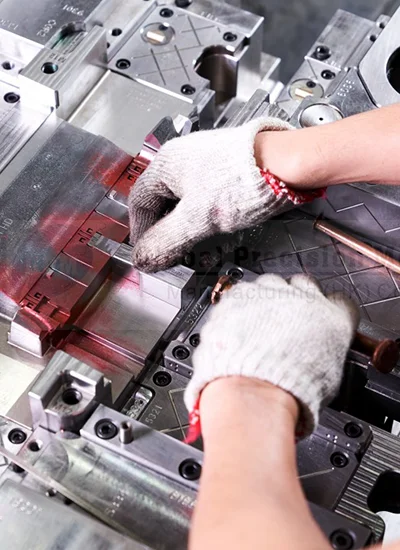
Proper injection mould maintenance is crucial for ensuring consistent product quality, extending mould life, and maintaining a safe working environment. Here are 20 practical tips to help you optimise your mould operations.
Table of Contents
- Daily Inspection
- Lubrication
- Cleaning
- Proper Storage
- Rust Prevention
- Preventive Maintenance
- Mold Temperature Check
- Safety Interlocks
- Emergency Procedures
- Documentation
- Mold Refurbishment
- Thermal Shock Prevention
- Pressure Monitoring
- Operator PPE
- Environmental Compliance
- Continuous Improvement
- Mold Life Tracking
- Spare Parts Inventory
- Quality Checks
- SOPs and Training
1. Daily Inspection
Check all critical components daily, including ejector pins, slides, guide pins, and cooling connections, to detect wear or damage early. Look for bent pins, unusual wear, or coolant leaks that may affect product quality.
2. Lubrication
Apply graphite or molybdenum disulfide to moving parts to reduce friction, prevent galling, and extend the life of slides and ejectors. Ensure lubrication is clean and applied according to manufacturer guidelines.
3. Cleaning
Remove plastic residues, flash, and debris after each production run. Avoid harsh chemicals that can degrade mould steel or coatings. Use soft brushes or non-abrasive cleaners for sensitive areas.
4. Proper Storage
Store injection moulds in a dry, temperature-controlled environment to prevent corrosion, warping, or deformation. Use labelled storage racks to organise moulds and track usage efficiently.
5. Rust Prevention
Apply anti-rust sprays or protective coatings to idle moulds. This prevents corrosion and ensures smooth operation when moulds are brought back into production.
6. Preventive Maintenance
Replace worn bushings, pins, slides, and seals every 50,000–100,000 cycles or as needed based on wear indicators. Proactive maintenance reduces unexpected downtime and repair costs.
7. Mold Temperature Check
Verify that mould temperature is stable before each production run. Use thermocouples or infrared sensors to avoid defects such as warping, sink marks, or flash due to thermal inconsistency.
8. Safety Interlocks
Inspect all sensors, locks, and safety switches before operation to protect operators. Ensure interlocks prevent the machine from starting if the mould is not correctly positioned.
9. Emergency Procedures
Define and train staff on clear steps for handling stuck moulds, hydraulic failures, or mechanical jams. Keep emergency tools and hydraulic release procedures easily accessible.
10. Documentation
Maintain detailed maintenance logs and production records. Track cycle counts, inspections, refurbishments, and operational issues. Documentation helps plan preventive maintenance and predict mould replacement.
11. Mold Refurbishment
Periodically re-polish, re-grind, and re-coat inserts to restore precision and surface quality. Use proper grit levels, polishing compounds, or plating techniques to maintain optimal product finish.
12. Thermal Shock Prevention
Avoid sudden temperature changes that may cause mould cracking or distortion. Gradually ramp up or down the mould temperature during start-up and shutdown procedures.
13. Pressure Monitoring
Regularly check injection and clamp pressures to ensure consistency in product quality. Monitor hydraulic systems for leaks or pressure fluctuations affecting part integrity.
14. Operator PPE
Equip operators with gloves, eye protection, anti-static gear, and heat-resistant equipment as needed. Emphasise proper handling techniques to reduce injury risk.
15. Environmental Compliance
Manage cooling water, lubricants, and cleaning agents according to local environmental regulations. Implement water treatment or recycling systems when possible.
16. Continuous Improvement
Analyse production defects and implement feedback loops to optimise mould performance. Encourage operators and engineers to report recurring issues for process improvement.
17. Mold Life Tracking
Record cycle counts, refurbishment dates, and operational history to schedule maintenance effectively. Predictive tracking maximises mould lifespan and reduces unplanned downtime.
18. Spare Parts Inventory
Maintain an inventory of high-wear components such as ejector pins, slides, and bushings. Ready access to spares reduces downtime and keeps production on schedule.
19. Quality Checks
Perform dimensional and visual inspections of every batch. Check for surface defects, flash, sink marks, or warping, and document findings for quality control and continuous improvement.
20. Standard Operating Procedures (SOPs) and Training
Develop and enforce SOPs for all moulds, including start-up, shut-down, cleaning, and emergency procedures. Provide regular training to update operators and engineers on new techniques, materials, and safety protocols.
Conclusion
Adhering to maintenance, safety, and best practices is critical for extending mould life, maintaining consistent production quality, and ensuring operator safety. By combining daily inspection routines, preventive maintenance, proper storage, and continuous training, manufacturers can achieve reliable, high-quality output while maximising their investment in mould tooling.
TECHNICAL QUESTIONS
Frequently asked questions-Injection Mould Maintenance and Safety
It extends mould lifespan, improves part quality, and prevents unexpected production shutdowns.
Daily inspection is recommended, especially before the start of each production shift.
Every 50,000–100,000 cycles, or when wear is detected.
Tolerances depend on the material and process but typically range from ±0.05 mm to ±0.1 mm for most parts.
Use PPE, verify safety interlocks, and follow documented emergency procedures.