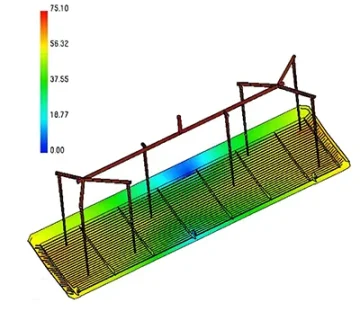


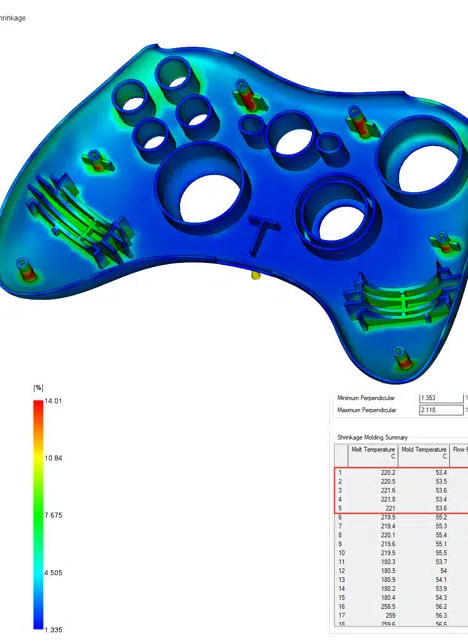
Plastics Shrinkage Rate & Mold Shrinkage Rate
Understanding plastics and mold shrinkage rates is essential for accurate product design and efficient manufacturing. Each plastic material behaves differently during the molding process, so designers must factor in the shrinkage rate to ensure the final product matches the intended dimensions.
At DSW, we provide a comprehensive shrinkage rate chart for the most commonly used plastics. This helps designers verify their calculations when preparing designs for mold manufacturing. Additionally, our team offers expert guidance to help you select the best materials for your project, ensuring quality results every time.
Importance of Plastics Shrinkage Rate
Plastics shrinkage rate refers to the percentage of size reduction a part experiences as it cools and solidifies after injection molding. Designers must account for this shrinkage to avoid issues like improper fitting, dimensional inaccuracies, or warping.
Shrinkage rates can vary significantly between materials:
- Low-density polyethylene (LDPE) has a higher shrinkage rate (up to 2.0%) compared to more rigid plastics like PVC, which has a much lower rate (0.4%).
- The addition of materials like glass fiber (GF) can also influence shrinkage. For example, adding 30% GF to polypropylene (PP) reduces its shrinkage from 1.8% to as low as 0.4%, improving dimensional stability.
Understanding these differences is key to creating products that meet both design and functional requirements.
Plastics Shrinkage Rate
| Plastics | Category | Shrinkage Rate (%) | Shrinkage Rate (Add. 30% GF) (%) |
| LDPE | General Plastics | 2 | 0.5 |
| HDPE | General Plastics | 2 | 0.4 |
| PP | General Plastics | 1.8 | 0.4 |
| PS | General Plastics | 0.6 | 0.1 |
| PVC | General Plastics | 0.4 | 0.1 |
| PMMA | General Plastics | 0.5 | 0.1 |
| ABS | General Plastics | 0.6 | 0.1 |
| NY6 | Engineering Plastics | 1.5 | 0.4 |
| NY66 | Engineering Plastics | 1.5 | 0.4 |
| PBT | Engineering Plastics | 2 | 0.4 |
| POM | Engineering Plastics | 2.5 | 0.5 |
| PC | Engineering Plastics | 0.6 | 0.1 |
| PPO | Engineering Plastics | 0.6 | 0.1 |
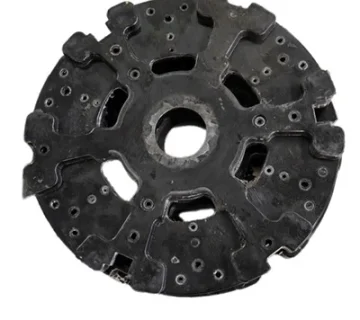
Case Example: Reducing Sink Marks in a Plastic Ring Cover
In this project, sink marks were observed near thick sections of a molded plastic ring cover
(Figure 1), caused by localized shrinkage during cooling.
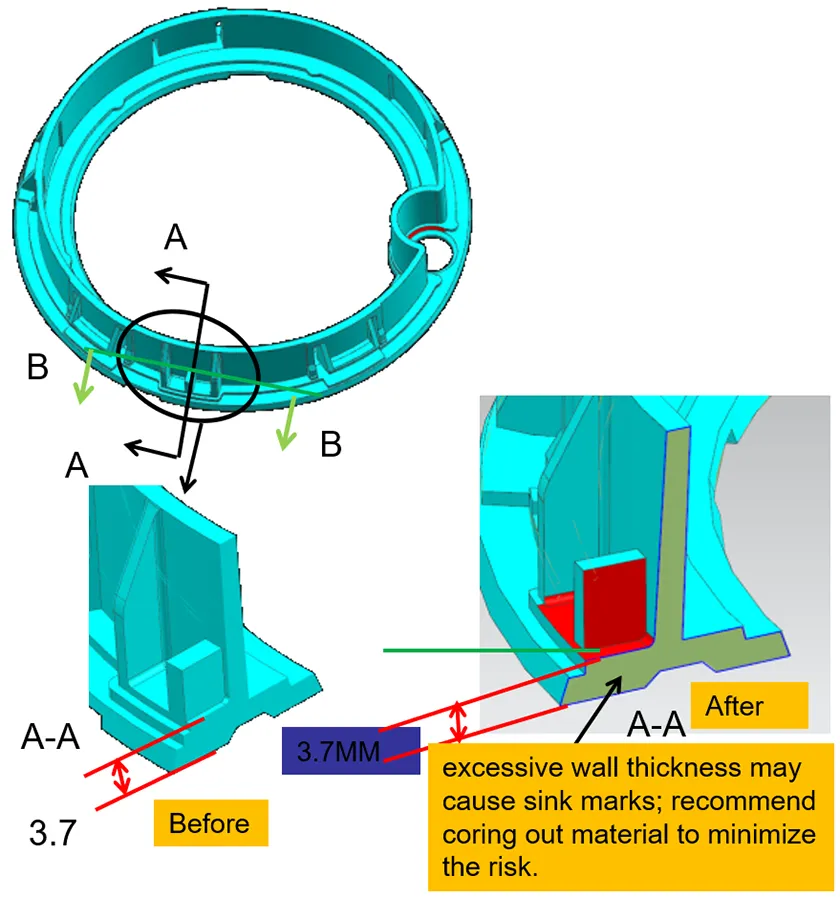
To resolve the issue, material was locally cored out to reduce mass concentration.
Additionally, reducing the wall thickness at the rib root
(Figure 2) further minimized sink mark formation.
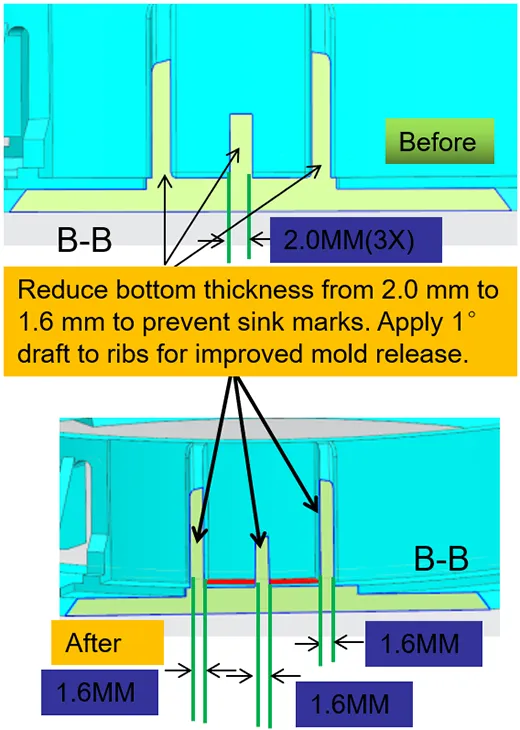
These design improvements led to significantly better surface quality and dimensional consistency in the final product.
Mold Shrinkage Rate and Its Impact
The mold shrinkage rate refers to the shrinkage that occurs within the mold cavity as the material cools. This rate directly corresponds to the plastic’s shrinkage rate and plays a critical role in determining the final size of the molded product. Manufacturers use this data to design molds that accurately produce parts with the desired dimensions.
DSW’s mold design and engineering team works closely with customers to ensure the mold shrinkage rate aligns with the material’s properties. This guarantees accurate, high-quality final products and minimizes the need for costly rework. Our expertise helps optimize the entire manufacturing process, from concept to production.
Practical Application of Shrinkage Rates
For example, when designing a part using PVC, which has a shrinkage rate of 0.4%, you’ll need to adjust the mold size to ensure the final part matches the intended dimensions. When working with glass fiber-reinforced materials, such as 30% GF polypropylene (which has a reduced shrinkage rate), mold calculations must account for this lower rate to avoid issues like product misalignment or dimensional inaccuracies.
Using accurate calculations and insight, our team at DSW can guide your material selection and mold design process to ensure that everything runs smoothly and your final product meets your exact specifications.
Mold Shrinkage Rate in plastic injection
Definition:
Mold shrinkage rate refers to the actual dimensional reduction observed in a molded part compared to its corresponding mold cavity. It is used to calculate how much larger the mold cavity should be designed to compensate for shrinkage during the cooling and solidification of plastic.
Formula:
Mold Shrinkage = (Mold Cavity Dimension − Final Part Dimension) / Final Part Dimension
Key Influencing Factors:
- Inherent plastic material shrinkage characteristics
- Mold design (cooling channel layout, venting efficiency)
- Machine parameters (injection speed, packing pressure, holding time)
- Part geometry and its location within the mold (different zones may shrink unevenly)
Plastic Shrinkage Rate vs. Mold Shrinkage Rate
| Aspect | Plastic Shrinkage Rate | Mold Shrinkage Rate |
|---|---|---|
| Definition | The material’s inherent tendency to shrink during cooling | The observed dimensional reduction of the molded part vs. the cavity |
| Calculation Basis | Based on material properties and testing data | Based on actual part and mold cavity dimensions |
| Purpose | Helps in selecting materials and estimating mold behavior | Guides the design of mold cavity dimensions |
| Influencing Factors | Material type, filler content, cooling rate | Same as plastic shrinkage + mold design + machine settings |
| Measurement Method | Measured under standard test conditions | Measured from the final part after molding |
| Application in Design | Used for initial estimation and material comparison | Used for accurate mold cavity dimensioning |
Partner with DSW
At DSW, we bring years of experience in mold design and manufacturing. Our team is committed to ensuring that your product performs as intended, from initial concept through final production. We offer personalized consultations to help you select the right materials, calculate shrinkage rates, and design molds that deliver the best possible results for your project.
If you need assistance with plastics or mold shrinkage rates or have any questions about material selection, don’t hesitate to contact us. We’re here to ensure your project’s success from start to finish.